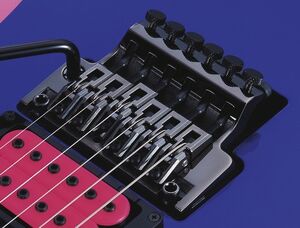
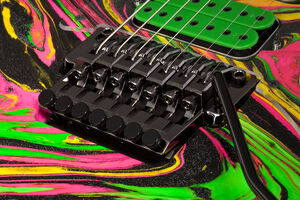
Often, when we walk into a store or surfing around the net, looking to buy an Ibanez Tremolo Vibrato (Floyd Rose) equipped electric guitar, we might usually be asking ourselves if this guitar comes with a decent bridge. Ibanez being a company with over 20 years of producing Tremolo Vibrato equipped bridges, there is no wonder that there are so many of them that leaves the potential buyer lost. Fear not, in this article, I shall introduce to my readers the common, popular different Tremolo Vibrato bridges that Ibanez has every produced.
Ibanez Original Edge 
Ibanez take on the Tremolo Vibrato Bridge. To many, this has been an all time favorite and is known for it's Tuning stability. The bridge has a spring lock bar and push in arm. Comes with Locking Studs.
Lo-Pro Ibanez Edge (Low Profile) 
Design is pretty similar to the Original Edge with a few exceptional differences. It has fine tuners moved to the back while it is heavier compared to the Original Edge. String lock screw is located at the saddle. Has the same tuning stability as Original Edge. Comes with Locking Studs.
Edge Pro 
The Edge Pro is the further modification of the Lo-Pro design. It features sound metal chips at the saddles that improves overall tone and can accept ball ends. It is the lowest profile Tremolo Vibrato Bridge. Tuning stability has been reduced because the locking studs which was included with the previous Edge incarnations were being excluded. However, Rich Harris from
Ibanezrules came up with a Locking Stud mod and with them installed the tuning stability is on par with Edge/Lo Pro. 2003
Edge Zero 
Ibanez created an all new tremolo system which supposedly has the ability to counter the flaw of every Tremolo Vibrato Bridge. That is the whole guitar going out of tune with the breakage of one string. This is known as the ZPS system. What this doe is, it is a giant spring that is placed at the tremolo cavity, acting as a counter force pushing the tremolo to a "Zero" position. It is of course switchable to a floating position by removing the ZPS system. The profile is slightly higher compared to Edge Pro. Features built-in intonation tool. Pre 2011, these come without the locking studs but from 2010 onwards, all of them are pre equipped with a pair of locking studs which therefore, increase stability.
Edge pro 2 
This is the cheaper version of the Edge Pro. The visual difference are the excluding of sound metal chips. It has poor tuning stability with it's weak knife edges. However, the routing is able to accommodate Original Floyd Rose without the need of further routing should the player desire to switch to a bridge with better tuning stability.
Edge III 
This was the bridge designed to replaced the Edge Pro 2 due to the conflict of patent rights with Floyd Rose. It features the same arm as the EP2.
Tuning stability is about the same compared to the Edge Pro 2. The routing is able to accommodate Original Floyd Rose without the need of further routing should the player desire to switch to a bridge with better tuning stability.
Edge Zero II 
The Edge Zero II was introduced in 2011 to replace the Edge III as it's mid range Ibanez Trem. This is so far the best midrange system ever made by Ibanez. It features the zero point system with all the functions of the Edge Zero with the exception of the intonation tool. It has way better Tuning stability compared to Edge III and features locking studs for better stability performance.
ZR 
The ZR is a Ibanez design Tremolo which functions close to a Khaler system. Instead of having Knife edges like the traditional Floyd Rose designed Tremolos, it uses a ball bearing-based pivot point instead. It has a different feeling compared to Knife Edge Tremolos but has great tuning stability none the less. This bridge also features a Zero point system which are existent in Ibanez Edge Zero series.
ZR II 
ZR II is the successor to the ZR tremolo. the main Tremolo system is the same as the original ZR tremolo with the exception being the use of a different alloy in the spring assembly and a new design of arm holder. The Original ZR system had a flaw where too much wood had to be removed for it's cavity and the arm holders breaks easily. This bridge has great tuning stability and features the Zero point system which are existent in Ibanez Edge Zero series.